Kratom Side Effects: What They Are and What You Can Do
Table of Contents
- Diving Into Kratom Side Effects
- FAQs
- The short transparent version
- What kratom is, and why kratom side effects vary so widely
- What the research actually documents
- How Product Format Can Shape the Experience
- Kratom side effects and product quality
- Who should avoid kratom entirely
- What to check before you buy
- The bottom line
- Sources and References
- Disclaimer
Diving Into Kratom Side Effects
If you've gone looking for information on kratom side effects, you've probably found the internet has two prominent stances on this topic: alarm bells, or a bunch of mixed stories from other users. Neither helps you decide anything.
So we’re giving you a useful version. What's actually been reported, how solid the evidence behind it is — and then the part almost nobody covers, which is how much of this is genuinely within your control. (Spoiler: more than you'd think.)
As always, you must be 21 or older to purchase these products and always enjoy responsibly.
FAQs
How long do kratom's effects last?
In a controlled human trial, mitragynine peaked around one to two hours, with a half-life from roughly 3.7 to 42.9 hours after a single dose — rising to 14.6 to 61.2 hours with repeated daily use.[4] The range is wide because everyone’s response can genuinely differ.
Is kratom addictive?
Kratom has habit-forming potential, and regular daily use may increase that risk silently. The FDA names substance use disorder — tolerance, withdrawal and craving patterns — among documented concerns.[1] Pharmacokinetic data showing accumulation over eight to nine days of daily use is consistent with regular use producing a different physiological state than occasional use.[4]
Does kratom cause liver damage?
The FDA lists liver toxicity among reported serious adverse events.[1] The published case literature is limited and causality hasn't been established. If you have an existing liver condition, speak with a clinician first.
What are the long-term kratom side effects?
This answer is still unclear. What we know is that long-term controlled human data is scarce and that the research hasn't been done enough in the form that could tell you either way. Case reports raise the question. Multiple controlled studies are what reveal more answers, and those are the ones still missing. Researchers state that causal mechanisms can't be identified from them.[2]
Why does kratom cause nausea?
Gastrointestinal kratom side effects are the most commonly reported.[2] Receptor studies show 7-OH inhibits gastrointestinal transit, which is basically constipation. It’s important to know that work was in isolated cells and rats, not people.[3]
Does kratom show up on a drug test?
Detection may depend on the half-life figures above, which vary considerably between individuals and with frequency of use.[4]
The short transparent version
- Reported kratom side effects tend to lean in the digestive, neurological, cardiovascular and psychiatric categories.
- The FDA also names liver toxicity, seizures, substance use disorder and neonatal abstinence syndrome among serious adverse events.[1]
- Much of that evidence comes from case reports, and researchers are upfront that causality can't be established from them.[2]
- The two headline alkaloids act in opposite directions at the same receptor — which is genuinely good news, because it explains why products differ and points at what to look for.[3]
- Contamination with Salmonella and heavy metals has been documented in some products. This is the one you have more control over than you may think, and we share more about how in the rest of this post.[1]
What kratom is, and why kratom side effects vary so widely
Kratom comes from the leaves of Mitragyna speciosa, a tree in the coffee family native to Southeast Asia.
"Kratom" names a plant, not a standardized product. Two bags with the same label may not be pharmacologically similar — which sounds like bad news until you realize it's the thing that makes shopping mindfully worth doing.
The alkaloids doing the work
Dozens of alkaloids live in the leaf, but two are the most abundant: mitragynine and 7-hydroxymitragynine (aka 7-OH).
Here's the part most summaries skip, and it's the most useful thing on this page. In lab testing on human receptor preparations, these two don't just differ in strength — they pull in opposite directions at the mu-opioid receptor. Which means: think of the mu-opioid receptor as a dimmer light switch. Mitragynine takes hold of the switch and “leaves it off” (it occupies the receptor without activating it). 7-OH takes hold of the switch about nine times more firmly — and nudges it partway up, not all the way (it occupies the receptor and activates it).
Scientists call Mitragynine an antagonist and 7-OH a partial agonist. Same switch, same leaf, opposite actions.[3]
So the useful question isn't whether a product is "strong." It's which of these two it leans on — and that's something a label should tell you.
Worth knowing: that work used isolated cells and rats, and the authors are clear that human effects can't be concluded from it. We treat that information as a mechanism, not prediction. It still tells you something practical — the ratio in a product matters more than any single number on the label.
Read more: Understanding Kratom Alkaloids and Their Properties
Why kratom side effects vary so much between products
A different alkaloid, a different experience:
If the two main alkaloids work against each other, then that means a product formulated around one of the alkaloids isn't a stronger version of a product formulated around the other alkaloid. It's a different experience altogether. Realizing this may help you see through most of the marketing lingo you’ll see on products.
Variances in how long the effects can last:
Kratom doesn't fully clear your system before the next use – it accumulates.
Picture a bathtub with the drain open.
- Each serving is water going in from the tap.
- Your body clearing it is the drain.
- If you turn the tap back on before the tub empties, the water line starts higher than last time.
If someone does that daily, then the baseline keeps creeping up. But then after about eight to nine days, the tub starts to drain as fast as the water that comes in. That's steady state: the level stops climbing, but it settles somewhere well above where you started.
We’re not trying to call your temple a tub but you get the idea.
Someone a week into regular use isn't in the same place as someone on day one, even with the identical product. So if something feels different than it did last week, that's not mysterious, it’s the mechanics of pharmacokinetics. Knowing that is half of managing it.
In a randomized, double-blind, placebo-controlled trial in healthy adults, mitragynine's half-life ran 3.7 to 42.9 hours after a single dose. With repeated daily use, half-life* climbed to 14.6 to 61.2 hours. Steady state took eight to nine days.[4]
* A half-life is the amount of time it takes for a changing quantity to decrease to half of its starting amount
So what more does this mean for the user:
- Pattern of use is one of the few things here entirely within your control from the start. As always, partake responsibly.
- Day 1 and day 8 are not the same experience, even with the same product from the same batch.
- If week two feels different than week one, that's not the product changing. That's the tub’s baseline.
- Everyone’s timeline varies. Your experience won’t be someone else’s experience. The range is enormous and highly individual.
What the research actually documents
The honest summary of the kratom side effects literature: it's broad, it's real, and it's sparse. The FDA also acknowledges that there is still so much more to learn about kratom scientifically.[1] Here's what has been reported and how we interpret it.
Digestive effects
Unglamorous, but it's also the category most people find manageable once they know to expect it. Turns out gastrointestinal effects are the most consistently reported — nausea, vomiting, constipation.[2] The receptor has a mechanism behind it too. 7-OH slows things down in the gut, and "slowed gastrointestinal transit" is just the clinical way of saying constipation.[3]
Neurological and cardiovascular reports
A narrative review organizes reported effects by organ system, with cardiovascular, neurological and psychiatric categories each outlined from case reports.[2] The FDA separately names seizures among serious adverse events.[1]
Worth keeping in mind: case reports and FDA adverse-event filings are voluntary, after-the-fact records. Case reports bring attention to something that happened. They don't count the far larger number of people who used these products uneventfully and the case reports shouldn't be used to generalize.
Liver concerns
The FDA lists liver toxicity among the more serious kratom side effects.[1] What to do with it: if you have an existing liver condition, we recommend you consult a trusted medical provider to get clarity on what is right for you.
Dependence and withdrawal
Of all the kratom side effects covered here, this is the one most shaped by how often you consume. This is the one the FDA names substance use disorder (e.g. tolerance, withdrawal, craving patterns) among documented concerns.[1] Given the half-life data above: daily use puts you in a different physiological state than occasional use. Which again also means that your tolerance baseline can be yours to mindfully manage from the start.
What the evidence can't yet establish
Most of the adverse-effect literature is case reports. The narrative review's authors say plainly that causal mechanisms are not able to be identified using clinical reports. They also note that in one state's review of kratom-associated deaths, polysubstance use was involved in at least 14 of 15 cases.[2] Which means a case report can tell you a person had a seizure after taking kratom, but not whether the kratom caused it. Something else to keep in mind: another substance, an existing condition, an adulterated product can't be ruled out from a report alone.
How Product Format Can Shape the Experience
| Format | What makes it unique | Factors that can shape the experience |
|---|---|---|
| Kratom Powder | Traditional preparation, most familiar | Alkaloid content varies batch to batch |
| Kratom Capsules | Pre-measured, no taste | Same variability, better consistency per unit |
| Kratom Tablets (extract or regular pressed kratom powder) | Pre-measured, portable | Check what binders are disclosed in the ingredient deck. Check concentration of key ingredient if it’s an extract. |
| Kratom Extract Shots | Concentrated liquid | Concentration of key ingredient is variable. Ideal to check. |
| Kratom Gummies | Fun, portable | Check what binders are disclosed in the ingredient deck. Check concentration of key ingredient if it’s an extract. |
| Kratom Drinks | Ready to consume | Same as shots: check concentration of key ingredient |
The further a product sits from plain leaf, the more you're relying on the manufacturer’s third party testing to show what the formulation involves, instead of the natural alkaloid variability from plain leaf.
Read more: Mastering Kratom: The Beginner's Guide to Dosages, Formats, and Safe Use
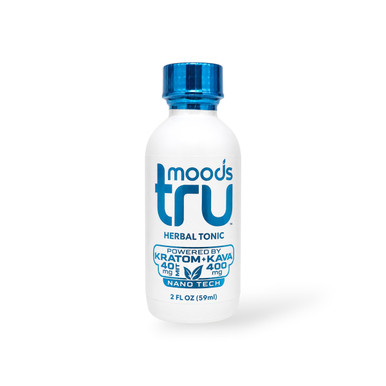
Tru Moods Herbal Tonic Blue Kratom + Kava Shot 2oz
$9.99
Tru Moods Herbal Tonic Blue Kratom + Kava Shot 2oz Tru Moods Herbal Tonic Blue Kratom + Kava Shot 2oz combines two well-known botanicals—kratom and… read more
Kratom side effects and product quality
Contamination, heavy metals, and adulteration
The FDA has warned the public when certain kratom products were contaminated with Salmonella and/or concerning levels of heavy metals — contaminants that, in the agency's words, can put people at risk and can result in numerous documented illnesses.[1]
This means, salmonella and heavy metals are not a kratom effect. Neither one comes from the plant. They're a result of supply chain failures that ended up inside a kratom product — contamination introduced somewhere in growing, processing, storage or packaging. This is why Current Good Manufacturing Practice (cGMP)* is highly valued in the industry.
*cGMP refers to a regulatory standard that ensures certain activities in manufacturing, packaging, labeling and holding of dietary supplements to ensure that a dietary supplement contains what it is labeled to contain and is not contaminated with harmful or undesirable substances such as pesticides, heavy metals, or other impurities.[5]
Concentrated extracts and 7-OH
7-OH comprises roughly less than 2% of the total alkaloid content in natural kratom leaves and is concentrated in some products, and as the receptor data shows, it's the alkaloid that binds the mu-opioid receptor far more strongly.[3]
Concentration changes a product's character, not just its intensity. Its regulatory status has also been moving rapidly. Check where it currently stands legally wherever you live rather than trusting anything written months or weeks ago, this page included.
Read more: The Power of 7-Hydroxymitragynine: What You Need to Know
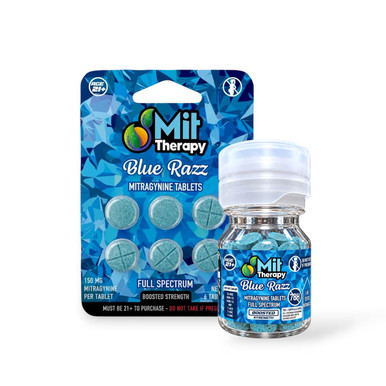
Mit Therapy Mitragynine Chewable Tablets Blue Razz 150mg
$16.95
Mit Therapy Mitragynine Chewable Tablets Blue Razz 150mg Mit Therapy Mitragynine Chewable Tablets Blue Razz 150mg offer adult consumers a convenient, flavorful option for exploring… read more
Who should avoid kratom entirely
Always consult a trusted medical provider, if you're wondering whether the kratom side effects above apply to you. Here are some of the obvious contraindications:
- Anyone under 21.
- Pregnancy. The FDA names neonatal abstinence syndrome among documented concerns, and the narrative review includes it as a category.[1][2]
- Anyone combining substances. Polysubstance involvement is mentioned in the literature on fatality.[2]
- Existing liver conditions.[1]
What to check before you buy
Most kratom side effects tied to product quality are answerable before you ever place an order. Five questions:
- Is there a current third-party lab report (COA), and does it cover heavy metals and microbial contamination?
- Does the report match the batch you're buying? A certificate from eighteen months ago may show information for a different batch.
- Is alkaloid content disclosed? Since mitragynine and 7-OH behave so differently, "strong" is not a specification.
- For extracts, is the concentration stated plainly in the report or on the product itself?
- Does the manufacturer answer all of this without friction or confusion?
Read more: Unraveling the Price Tag: A Comprehensive Guide to Kratom Cost Factors
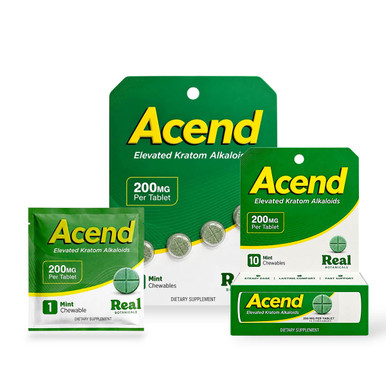
Acend Kratom Alkaloid Chewable Tablet Mint 200mg
$9.95
Acend Kratom Alkaloid Chewable Tablet Mint 200mg Acend Kratom Alkaloid Chewable Tablet Mint 200mg offers a convenient and modern alternative to traditional kratom powders, capsules,… read more
The bottom line
The documented kratom side effects are real and worth paying attention to. Always consult a trusted medical provider, review current batch lab reports. The evidence behind kratom side effects is thinner than it may seem. And the one risk that is more firmly established (contamination) happens to be the part you could have more autonomy over, when deciding which product to buy.
Stay safe, and enjoy responsibly.
Sources and References
- FDA and Kratom. U.S. Food and Drug Administration. Government agency page. https://www.fda.gov/news-events/public-health-focus/fda-and-kratom
- Health Effects Associated With Kratom (Mitragyna speciosa) and Polysubstance Use. Narrative review. https://pmc.ncbi.nlm.nih.gov/articles/PMC9130800/
- Pharmacological Comparison of Mitragynine and 7-Hydroxymitragynine. In vitro receptor assays and rat behavioral study — not human. https://pmc.ncbi.nlm.nih.gov/articles/PMC7923387/
- Human Mitragynine and 7-Hydroxymitragynine Pharmacokinetics after Single and Multiple Daily Doses. Randomized, double-blind, placebo-controlled trial in healthy adults. https://pmc.ncbi.nlm.nih.gov/articles/PMC10934259/
- U.S. Food and Drug Administration. "Current Good Manufacturing Practices (CGMPs) for Food and Dietary Supplements." FDA, content current as of April 24, 2024. https://www.fda.gov/food/guidance-regulation-food-and-dietary-supplements/current-good-manufacturing-practices-cgmps-food-and-dietary-supplements
Disclaimer
The products discussed here and any claims or suggestions made have not been evaluated by the Food and Drug Administration (FDA). This content is not intended to diagnose, treat, cure, or prevent any disease.
The information on this website is provided for general informational purposes only and should not be relied on as the sole basis for making decisions – we encourage consulting primary, qualified, more complete, or professional sources. Any reliance on the material on this site is at your own risk.
Information shared on this site may be updated at any time and may include information or data that are no longer current, accurate, or complete and is provided for your reference only. We are not obligated to update published content, and it is the reader’s responsibility to monitor any changes and to consult with primary, qualified, more complete, or professional sources.
We make no guarantees regarding the completeness, accuracy, or reliability of the information provided, nor do we warrant that any products, services, or materials offered will meet individual expectations. Use of this site and its content is at your own discretion and risk.